Master The Boards Step 3 by Conrad Fischer MD
The most trusted full-color review for USMLE Step 3. Sharpen recall, master high-yield concepts, and walk into exam day with total confidence.
- Exam-like focus on best initial diagnostic test and most likely diagnosis
- Current pharmacology updates with memorable callout boxes
- Practical tips for Computer-based Case Simulations (CCS)
Explore Master the Boards Step 3
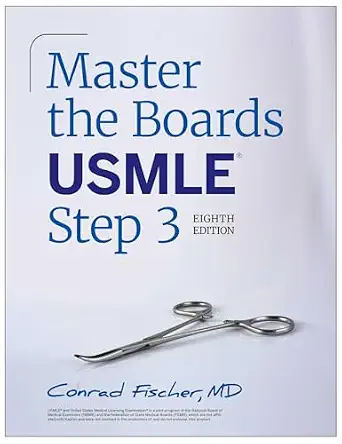
Master the Boards USMLE Step 3 — Eighth Edition (2026)
The flagship edition featuring hundreds of full-color diagnostic images, CCS simulation tips, and targeted pharmacology updates curated by Conrad Fischer MD.
Check Price
Master the Boards USMLE Step 3 — Kindle Edition
Read anywhere on any device. The Kindle edition delivers the complete Eighth Edition content with searchable text and vivid color images optimized for digital screens.
Check PriceInside the Book
Master the Boards USMLE Step 3, Eighth Edition is engineered around the way the exam actually tests you. Every chapter is built on three pillars: recognize the most tested presentation, select the best initial diagnostic test, and identify the most likely diagnosis — the exact framework Step 3 rewards.
Hundreds of clinical photographs and diagnostic images appear throughout the text, reinforcing visual recognition skills that directly translate to exam performance.
Drug tables and callout boxes are refreshed for the 2026 edition, ensuring the pharmacology you study matches what current clinical guidelines endorse.
Practical, step-by-step guidance for the Computer-based Case Simulation component — the portion of Step 3 that most exam-takers find least familiar.
Memorable summary boxes highlight the most commonly tested facts, making rapid review before exam day efficient and focused.
How to Read This Book
Follow this five-step study approach to get the most out of Conrad Fischer MD’s proven review system and walk into Step 3 fully prepared.
- 01
Assess Your Baseline
Before opening Chapter 1, take a timed diagnostic practice set to identify your weakest systems. This prevents you from spending equal time on strong and weak areas and allows the book’s structure to target your real gaps first.
- 02
Build a Realistic Study Schedule
Map out the book chapter by chapter over your dedicated study period. Allocate more days to Internal Medicine and Emergency Medicine — the highest-yield disciplines on Step 3 — and reserve the final week exclusively for CCS practice and callout-box review.
- 03
Read Each Chapter Actively
Work through each chapter using Fischer’s three-question framework: What is the best initial diagnostic test? What is the most accurate test? What is the most likely diagnosis? Annotate the callout boxes and color images as you read to build lasting visual memory.
- 04
Practice MCQs by System
After completing each system chapter, immediately attempt a block of practice multiple-choice questions on that topic. Review every explanation — correct and incorrect — before moving to the next chapter. This interleaved practice cements retention far more effectively than end-of-book cramming.
- 05
Run Full CCS Simulations
Use the CCS-specific guidance in the book alongside a dedicated simulation platform. Practice ordering initial workup, evolving management over time, and closing cases correctly. The CCS component is scored separately and a strong performance here can meaningfully boost your overall result.
Master the Boards Step 3 — Reader Reviews
With over 230 ratings and a 4.6-star average, here is what readers consistently highlight about this edition.
Product quality
R. Patel, MD Candidate
Clinical Clarity
The exam-like framing of every topic — best initial test, most accurate test, most likely diagnosis — completely changed how I approached clinical vignettes. After working through this book I stopped second-guessing myself on question blocks. The color images are genuinely useful, not just decorative.
Ease of use
J. Morgan, PGY-1 Resident
CCS Preparation
The CCS section is worth the purchase price alone. Most review books ignore the computer simulation component almost entirely. Fischer explains the logic of case management across time, which is exactly what the examiners are looking for. My CCS scores improved significantly after following his approach.
Overall experience
S. Kim, Medical Student
High-Yield Focus
Updated pharmacology, memorable callout boxes, and a writing style that actually teaches rather than just listing facts. The Eighth Edition feels noticeably current — the drug references reflect what you actually encounter in clinical practice. Highly recommended as a primary Step 3 resource.
Watch: Master the Boards Step 3 Overview
See how Conrad Fischer MD breaks down the Step 3 exam and explains what makes this review system uniquely effective.
About the Author
Conrad Fischer MD is one of the most recognized USMLE educators in American medicine. A clinician, teacher, and prolific author, he developed the Master the Boards series to reflect exactly how the NBME tests clinical reasoning — not rote memorization, but the structured thinking that defines excellent physicians.
His approach to Step 3 preparation centers on three repeating questions that mirror the exam’s own logic: identify the best initial test, determine the most accurate confirmatory test, and arrive at the most likely diagnosis. That framework, refined across eight editions, has helped hundreds of thousands of candidates pass Step 3 and match into the residency programs they want.
The Eighth Edition incorporates current clinical guidelines, updated pharmacology, and expanded CCS guidance — making it the most comprehensive and current edition to date. Whether you prefer print or digital, both formats deliver the full high-yield experience Conrad Fischer MD is known for.
Visit Official StoreFrequently Asked Questions
Is Master the Boards Step 3 sufficient as a standalone review book?
Many candidates use it as their primary text paired with a question bank for practice. The book covers the full scope of Step 3 content including CCS, making it a strong foundation. Supplementing with a dedicated MCQ resource is the most common and effective study strategy.
What is the difference between the print and Kindle editions?
Both editions contain identical content. The print edition is a full-color hardcopy ideal for annotating and desk study. The Kindle edition offers searchable text, adjustable font sizes, and the ability to study on any Kindle-compatible device — useful for commuting or clinical rotations.
How is the Eighth Edition different from previous editions?
The Eighth Edition includes updated pharmacology throughout, expanded CCS simulation guidance, current clinical guidelines, and refreshed full-color diagnostic images. It reflects the 2026 exam content outline and is the most current version available.
How long does it take to read the book cover to cover?
Most candidates complete a full read in three to five weeks studying two to four hours per day, depending on their baseline clinical knowledge. A second, faster pass focusing on callout boxes and images typically takes one additional week.
Is this book helpful for physicians seeking recertification?
Yes. While the primary audience is medical students sitting USMLE Step 3, the clinical reasoning framework and pharmacology updates make it a valuable refresher for physicians preparing for internal medicine or family medicine board recertification examinations.